Tuesday, 30 June 2015

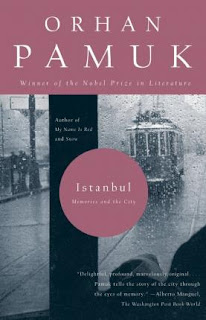
Istanbul (book)

How do you write a book to convey to someone the essence of an entire city? Especially a city as historically and culturally complex as Istanbul. Moreover, is it possible to do so with any kind of objectivity when one’s personal experiences of a place shape one’s impression of it.
Istanbul is by no means a travel guide but it definitely succeeds in giving the “feel” of the city.  Orhan Pamuk does a magnificent job of bringing together history, architecture, art, sociology, and his own memoire to produce that feeling.


Pamuk explores various medium which Istanbul has been perceived and discussed in the west and how this dialogue affected how Istanbul intellectuals and artists see their city.  He argues that this is not a true reflection of the city but a westernised and romanticised version; because historically there was so much pressure for Istanbul to become westernised the opinions of the west were lapped up without much criticism or self-reflection by the Istanbul intellectuals. This resulted in a disconnect between how the common people felt about their city and how the intellectuals described it.

Reading Istanbul made me reflect on Foucault’s argument about knowledge and power.  The city’s academics and artists were the ones who held the knowledge of the psychology of the city. While pertaining to speak the truth, their views were in reality influenced by more powerful knowledge holders from the West: more powerful because Westernisation became synonymous with civilisation.

By the same token, Pamuk realises that his opinion of the city is also coloured by his moods which are affected by his relationship with his parents, friends and his lovers.  Places he had been before with a heavy heart and which appeared dark and depressing were more positive when he visited them as a middle aged man at peace with himself.

Writing this review also made me think about how people perceive themselves and the way people try to control the way they are perceived by others via exposure in Facebook, Instagram and the like.  It may be comforting or disturbing (depending on the subjective opinion) to think that what others think of you is not actually what you are.  Further, what you think of yourself is affected by how you are feeling and your relationship with others – whose personalities you have little control over.

A guide to a location, such as a travel guide, often display the opinion of the author so the reader loses him or herself in the subjectivity which prejudices their own experience.  Where it comes to describing foreign destinations and its people, travel guides often denigrate to stereotyping or exoticising: resulting in vapid statements such as “the locals love to ride bicycles” (excerpt from the Lonely Planet). What makes Istanbul different is Pamuk’s realisation of and interaction with this process.


Thursday, 25 June 2015

American Beauty (film)

American Beauty (Directed by Sam Mendes)/1999
 
American Beauty had such a massive impact on popular art-cinema that at times it seems a bit of a cliché. It has the weird depressed artistic kid, the self-help infatuated business people, the hyper-sexualised blonde girl, the emasculated dad, the evil corporate boss, and the repressed homophobic military man. Yet, I think the feeling of cliché that can affect the viewer of this movie is mostly the result of the influence it had on how the disaffection of modern American culture was portrayed in the television shows and movies that followed rather than due to an inherent flaw in the movie.
 
This is a movie about the meaninglessness of modern American life. It shows the breakdown of the family unit, where all family members are against each other in a domestic cold-war. Individuals working in companies are treated without respect and do not feel any purpose and hence motivation to perform their job well. Those that do feel passion for their work do so out of a lack of true self-esteem and embrace a self-help, Tony Robbins type culture that comes across as extremely odious to those that see through the mask of professionalism. Youth are depressed and disconnected from their parents; those that have a more creative streak are out casted by materialistis in the school system and readily engage in devious behaviour. Old school Americans feel lost in a system that no longer respects toughness and stoicism but are unable to embrace the emotional and sexual liberalism of the modern world.
 
American Beauty attempts to capture the malaise of modern America and provides somewhat extreme versions of the different manifestations that this takes. Watching this movie I was struck by the fact that every character in this movie was white and middle-class. In this sense, American Beauty is limited by the fact that it is a presentation of the ills only affecting a small and privileged group within a wealthy, developed country. This fact could be viewed as reflecting the fundamental immaturity of the individuals portrayed as they are not able to enjoy their privilege. On the other hand, suffering is always subjective, and all humans face pain in their own way, framed by the circumstances that shape their lives. It therefore displays the confusion and absurdity of a very specific social class, but does not act as a more robust statement on humanity as a whole.
 
One key point in American Beauty is the role of sexuality. Individuals are shown to seek refuge from their lives through sex: both fantasy and real. The movie displays the futility of this approach. The fantasy either will not meet our expectations, or will die off into another form of boredom or pain. There is no real redemptive quality to this message: no one seems to transcend it or come to terms with the reality of it. Lester Burnham, played by Kevin Spacey, seems to encounter this head-on later in the movie, but this experience hardly plays an important role in the development of his life or character nor of the movie.
 
The weakness of the movie lays in its beginning and conclusion, which both involve Lester speaking of his past life as if in some kind of afterlife. This is the narrative technique used, but is not properly incorporated into the rest of the movie or explained. Possibly the movie was saying that the foolishness of life is only fully seen by those that have ceased living, or that there is some kind of religious meaning to all the suffering that plays out in human life. However, it has the feeling of something tacked onto the movie without much reflection on what it is meant to portray.
 
Finally, the bleakness of the message is made viewer friendly due to the fine work of the director, Sam Mendes. It is shot in a soft, playful and stylistically lush way. The colours are bright and the movie is upbeat. All of this led to the huge popularity of this movie as while presenting a harsh message, American Beauty is an enjoyable, playful and humorous film.