Saturday, 13 December 2025

Endurance (book)


There are moments in history when a man sets out to claim a treasure, and instead discovers that the true treasure has been claiming him all along. Ernest Shackleton sailed south in search of an earthly feat: crossing the last vast continent, writing his name into the white margins of the map. But the ice had its own liturgy. It closed around his ship Endurance like a stilled heartbeat, and the expedition that began as ambition became a pilgrimage. Shackleton left England seeking triumph; he returned, not with glory, nor with wealth, nor with achievement, but with something quieter and rarer: every soul entrusted to him.

It is here that Jesus’ teaching echoes: “Do not store up for yourselves treasures on earth, where moth and rust destroy, and thieves break in and steal. But store up for yourselves treasures in heaven.” (Matthew 6:19). Shackleton did not quote this verse, but he lived it. For while his earthly mission failed and his dream was crushed between the ice floes, he stored up a treasure no frost could touch: sacrificial leadership, integrity under pressure, and a devotion to his men that bordered on the pastoral.

Shackleton’s story is almost biblical in contour. Like Abraham leaving the familiar, he journeyed into a land of snow and silence. Like Moses shepherding the Israelites through the wilderness, he wandered with his men across shifting ground, guiding them with a fragile but determined hope. Like Paul in the storm-torn Mediterranean, he stood on a deck battered by the elements and told fearful hearts, “Hold fast.”

There is something profoundly kingdom-shaped in a leader who measures success not by conquest but by the preservation of life. When the Endurance splintered and sank beneath them, the expedition died, but Shackleton was reborn. No longer the commanding explorer seeking a crown, he became the servant-leader seeking the salvation of others. In a strange and beautiful way, the wreck delivered him from the seduction of earthly treasure. Ice stole the expedition, but God gave him a mission.

Every decision thereafter is a lesson written in cold ink across the Antarctic night: He shared the hardships: sleeping in the same frozen tents, eating the same meagre rations, never shielding himself from discomfort. He guarded morale: telling stories, issuing tiny luxuries of hot milk or tobacco when spirits dipped, knowing the soul can starve before the body does. He sacrificed personal comfort: giving others the warmest sleeping spots, staying awake to keep watch, refusing privilege when equality sustained trust.

He carried hope like a lantern: quiet, steady, refusing to let the flame go out in the tempest. These are not traits of earthly treasure-hunters. These are the treasures of the kingdom: faithfulness, service, courage under trial, humility under pressure, love in action rather than sentiment. Shackleton’s failure became the soil in which these treasures grew.

And so the expedition becomes a parable: that sometimes God thwarts the mission we want so He can reveal the mission He entrusted to us. Shackleton never conquered Antarctica, but he conquered despair. He never crossed the continent, but he crossed the boundaries of self-interest and found the terrain of sacrificial love. He did not return with accolades, but he returned with his men alive—every single one. In the divine arithmetic, this was success far greater than earthly achievement.

In Scripture, leadership often emerges most clearly not in triumph but in trouble. David’s heart was revealed in the caves of Adullam; Joseph’s wisdom in the prisons of Egypt; Daniel’s faithfulness in the courts of Babylon. Shackleton’s leadership was forged not on the proud deck of a ship departing Southampton but on the trembling edge of an ice floe, under a sky empty of guarantees.

The question for us is simple: What are we storing up and where? Are we stockpiling recognition, achievement, security, applause? Or are we cultivating character, compassion, perseverance, and faith?
Shackleton reminds us that earthly treasure is fragile. Ice can crush it, time can erode it, circumstance can overturn it, but kingdom treasure grows precisely in the places where earthly treasure fails. His leadership teaches us that:
  • true greatness is measured by the wellbeing of others, not the elevation of self;
  • godly leadership is less about the size of the mission and more about the posture of the heart;
  • hope is a responsibility, not an emotion; something leaders must carry for others when the sun disappears;
  • failure in earthly terms often becomes the doorway into spiritual formation; and
  • sacrifice is not the loss of treasure, but the investment of it.
Perhaps the most enduring image is Shackleton rowing the James Caird through monstrous seas toward South Georgia, half-starved yet refusing to surrender. It is a picture of intercession; one man battling the elements for the sake of those who waited, trusting him as their lifeline. It is Christlike in shape: the shepherd going after his flock; the leader laying down his own comfort, even his life, for those he loves.

We may never face Antarctic winds, but we all face seasons where the ice closes in; plans collapse, ambitions slip beneath the surface, the world grows quiet and cold. And in those moments, Shackleton whispers across time: 'Do not cling to what is sinking. Save what is eternal.'

For the true journey of the Endurance was never about reaching a continent. It was about revealing a soul; one that, stripped of earthly success, reflected the qualities of a kingdom not made of ice or stone but of righteousness, mercy, and love. May we lead as he led; storing treasure where the cold cannot touch it.

Tuesday, 7 October 2025

Black Rabbit (Netflix series)

The phrase “Black Rabbit” first entered popular culture through Richard Adams’ 1972 fantasy novel Watership Down. In it, a small group of rabbits is portrayed anthropomorphically, complete with their own culture, language, and mythology. The Black Rabbit of Inlé serves as a grim reaper figure, arriving when a rabbit’s time has come to guide them from life to peace. He is a servant of Lord Frith, a sun-god who, according to rabbit mythology, created the world. Since then, “Black Rabbit” has come to symbolize the confrontation with darkness, the shadow self, and transformation. The Netflix show Black Rabbit seems to embody this concept as a reflection of contemporary America’s shadow self.

There’s something peculiar about time in the show, hinted at by the identical watches given to brothers Jake and Vince by their father. In the first episode, a robber wrestles Jake for his watch, and Vince’s watch is stolen early on. The narrative is riddled with anachronisms: cheques and cash instead of crypto; underground casinos rather than online gambling; heroin instead of fentanyl. Nostalgia permeates the story—cassette tapes, photographs, and memories of the past. The timeline is ambiguous, but what’s clear is that the brothers are trapped in the same nightmare as their parents’ generation: poverty, violence, infidelity, intoxication, and addiction repeat across generations. The shadow self is symbolically killed—by a falling bowling ball and a plunge from a building—leading to Jake’s supposed rebirth. Yet, there’s something eerie and artificial about it. In the final scene, we realize this “new life” is counterfeit, dressed up as noble but merely echoing his father’s footsteps as a bar owner.

They say the truth will set you free—a phrase that traces back to Jesus. The truth here is that contemporary America is ensnared in a generational curse. Each generation attempts to escape it, only to find itself back in the same pit. It’s like trying to get clean by rubbing mud all over oneself. Black Rabbit evokes The Brothers Karamazov by Dostoyevsky, another tale of brothers killing their father. But Dostoyevsky included a third brother—a priest—who represented goodness and purity. In Black Rabbit, there is no such figure. America, it seems, denounced God long ago. Jake and Vince cry out to God and Jesus Christ—not in prayer, but in despair and profanity, with their backs to Him. Society is too proud to turn to God, yet too broken not to cry out.

The absurdity is evident early on when jewelry is transacted at the Black Rabbit. Jewelry—metal and stones with no practical use—commands absurd prices. Other illusions follow: artwork, gourmet hotdog, interior décor, media, dance, sports—the list goes on. Vince may call himself a former addict, but the culture around him is addicted to distraction, numbing discomfort with spectacle. The final montage, supposedly showing fresh starts, reveals characters repeating the same patterns. Jake’s new role as a bartender in a fancy bar is laughable—it’s no different in substance from a street-corner dealer. The setting may be polished, but the function remains the same. It’s reminiscent of Tony twirling in the kitchen while the restaurant is about to be sold to the mafia or its owner killed.

I’ve come to believe that cultural artifacts like this show, regardless of the creators’ intentions, reflect the spiritual state of society. I’m unsure whether the show intentionally ends with no real change. After The Brothers Karamazov, Russia experienced a revolution led by the Bolsheviks, whose anti-religious campaigns led to widespread violence against Christians—almost as if the novel’s patricide foreshadowed reality. I don’t foresee such upheaval in America; the “Father” was killed long ago, as Black Rabbit suggests.

Emanuel Swedenborg, an 18th-century scientist and mystic, wrote about his visions of heaven and hell. He argued that we cannot truly know good and evil unless we define good as what is good in God’s sight, and evil as sin because God is the source and definition of goodness. Turning away from evil is inherently good but only if we recognize evil as sin. Otherwise, we merely hide it from public view. This idea resonated with me while watching Black Rabbit, which presents a world where no one knows what is good or bad. Laws exist but are routinely broken by shadowy organizations. Social expectations and cultural norms are stacked like a house of cards. We see this confusion when Jake and Roxie argue over Jake’s treatment of Anna—he acted as an employer, Roxie expected friendship. We see hypocrisy when Gen mocks Vince for his drug addiction while she routinely indulges in alcohol and weed. We see warped justice when Anna receives financial compensation while Jules, the rapist, remains free.

Much of today’s world suffers from this same lack of clarity in good and evil—whether due to cultural relativism or political ideology. This is the spiritual damnation, the generational curse we face. We go in circles, each generation slightly different but fundamentally the same—like the latest model of a smartphone. 

Thursday, 13 April 2023

I See Satan Fall Like Lightning (book)

Humanity tends to scapegoat individuals or groups to water the thirst for collective violence or to resolve tensions and angst. The scapegoating mechanism is at the heart of the Western canon: both Socrates and Jesus were put to death to appease the inflamed crowd. According to French American thinker René Girard, these are extreme, archetypal versions of a phenomena that plays out in lesser forms throughout human life.

Girard sits at the crossroads of various traditions but is uniquely brilliant when discussing the role collective violence has in human communities. At the heart of Girard’s work is the notion of mimetic decision-making. By this he means that humans by nature imitate what they see, hear, and read, including in what they desire. The imitators inevitably begin to go after the same things in a world of scarce resources, which increases tensions in the community. Eventually, the tension becomes too great, and the individual or group is selected for scapegoating, whereby the masses direct their rage and frustrations onto the scapegoat, who is labelled, attacked verbally and at times murdered.

The division between need and want is important here. For Girard, our needs are instinctual, and our wants are mimetic. In essence, once our survival instincts are met, our desirous minds begin to want things other people have or desire. The obvious result of this is unchecked and potentially destructive patterns of competition and desire. Economic and political decision-making is driven by the desire to be recognised, accepted, and praised by others, and is a highly intersubjective phenomena that cannot be narrowed down to the decisions of independent agents.

Of late, Girard’s thought has been making inroads into economic theory, partly driven by Peter Thiel’s enthusiasm for his Stanford professor’s ideas. When reflecting on how Girard’s theory helped him in business and life, Thiel notes that the mimetic nature of human decision-making leaves room for highly successful contrarian investors as the market cannot be rational when consumers and investors are swept up in mimetic contagion. However, perhaps more importantly, Thiel argues that if we can understand the scapegoating mechanism and the tendency to fight over what we mutually desire, then we can more effectively cut off the scapegoating process in our workplaces and political communities.

It was however through his theological text I See Satan Fall Like Lightning that I encountered and became deeply interested in Girard’s work. In this book he approaches the Bible through his mimetic worldview. He works to “demythologise” the concept of Satan by turning the Prince of this World into a personification of scapegoating rather than a living entity. He does this because, for him, the process is impersonal as the vast majority of those caught up in the scapegoating are not aware they are captured by behavioural contagion.

He argues that Pontius Pilate, like many political leaders, gives into mimetic contagion as a way of ensuring the future stability of the community and his position in it. After seeing the crowd reaction to his offering up of Barabbas, Pilate understands that the crowd can only be placated through the murder of Jesus via the scapegoating process. Moreover, even Peter, one of Christ’s loyal followers, gives into the mimetic contagion, fulfilling Jesus’ prophesy that he would be betrayed three times before the rooster crowed. The spirit of collective action and acceptance is thereby revealed as seductive to all humans regardless of station.

One curious aspect of this view of human conduct is that mimetic contagion can look a lot like conspiracy. That is, the uniformity of senseless action across a wide range of people, including leaders, can appear so coordinated that one is automatically left searching for an external hidden hand. However, we also know that the mimetic nature of human beings is continuously taken advantage of by advertisers, influencers, celebrity culture, spin doctors and nudge units. Perhaps the two notions are complimentary rather than opposed; or put another way, nefarious social actors use our mimetic tendencies against us to achieve ends unknown to those immersed in the frenzy. The saving grace in the whole affair is that for Girard our mimetic character enables us to enter relationships involving positive reciprocity. For this, we need cultural figures, politicians, and artists that can provide compelling, positive behaviors for the collective to imitate, with forgiveness the most potent personal safeguard against spiraling mimetic rivalries. It is not enough to merely expose those among us pushing society towards corruption, violence and the scapegoating of individuals and groups. Finally, we need a cultural environment built on the inherent dignity and rights of all people regardless of their group identity, because without this, we too easily revert to the tyranny of the masses and the scapegoating of individuals and groups to sedate the crowd.

Monday, 7 March 2022

The Nag Hammadi Scriptures (book)

History rhymes: it moves in cycles of growth, destruction and then further growth; we see intense conflict followed by loving peace, leading to complacency and the withering of what brought the beauty and success to begin with, only to give birth to something greater. Another common historical rhyme is that each age has a wealthy establishment which attempts to suppress information or people that threatens its control: Emperors, Tsars and tycoons. Any serious student of world history, mythology and ideas knows these things to be true.                                                                                                              
The Nag Hammadi Scriptures have captured the imagination of seekers around the world because their story and content exemplify the points raised above. In brief, they represent a type of Christianity that flourished between approximately 70 AD to 400 AD but ceased to exist thereafter. They are called gnostic which generally means a direct knowledge of the truth. However, while they are diverse and defy being pinned down by a single word, these texts were lumped into a single category when a significant second century Catholic bishop named Irenaeus equated the term heretic with the word gnostic as part of the early attack on this style of Christian thought. 

The maniacal siege on these Greek-Egyptian mystics reached its crescendo in 367 AD when Athanasius, the Archbishop of Alexandria, called for all texts outside of those acceptable to the political-religious establishment to be stolen and burned on the grounds they were heretical. Elaine Pagels’ succinct and important work The Gnostic Gospels does a great job in outlining the forces at play during the period. The indications are that once the great purge started the monks living in St Pachomius, in modern day Egypt, buried the Nag Hammadi collection for individuals to find in a more receptive period. 

Flash forward to 1945. The second world war is complete, and the collective mind is ready for an opening of consciousness. The Nag Hammadi Scriptures were accidentally discovered by bandits on the run after avenging their father’s murder. When digging for soft soil to use as fertilizer they hit upon the red earthenware jar containing the texts. After attempted black market transactions, and subterfuge of various forms, the newly discovered Scriptures exploded into centres of learning in the 1960s. It was certainly the best time for them to arrive on the scene, as authority was being questioned in all directions, and people were becoming increasingly interested in cross-faith learning. 

The Crown Jewel of the Nag Hammadi collection is in my opinion the Gospel of Thomas. This text is dated by experts, such as Helmet Koester, as being compiled in approximately 140 AD but written down and taught from between 50 AD to 100 AD. He suggests the Gospel may be even earlier than the four New Testament Gospels, Matthew, Mark, Luke and John. Upon reading the Gospel of Thomas, one notices two things: firstly, the intensely philosophical nature of the sayings, with some reading as if they were right out of the works of Plato; secondly, an occasional similarity to the ideas found in Buddhism. There is a school of thought that the Christians who followed the Gospel of Thomas interacted with Buddhist and Vedic scholars more broadly. It was around this time that trade routes between the Greco-Roman and the far East were beginning to flourish. Elaine Pagels notes that Hippolytus a Greek Christian wrote about Brahmanism in 235 AD. 

To learn more about the Gospel of Thomas, my suggestion is you read or listen to it. Part of the charm of the text is how direct it is: you feel as if Jesus is talking straight at you due to it consisting of a series of wisdom sayings rather than being in the narrative form of the New Testament Gospels. Some of my favourite sayings from the text are: 

“Jesus said, "If your leaders say to you, 'Look, the (Father's) kingdom is in the sky,' then the birds of the sky will precede you. If they say to you, 'It is in the sea,' then the fish will precede you. Rather, the (Father's) kingdom is within you and it is outside you.” 

"The Pharisees and the scholars have taken the keys of knowledge and have hidden them. They have not entered nor have they allowed those who want to enter to do so. As for you, be as sly as snakes and as simple as doves.” 

“Jesus said, "If they say to you, 'Where have you come from?' say to them, 'We have come from the light, from the place where the light came into being by itself...If they say to you, 'Is it you?' say, 'We are its children, and we are the chosen of the living Father.' If they ask you, 'What is the evidence of your Father in you?' say to them, 'It is motion and rest.'" 

We are at another point of time where information is considered dangerous. This time the establishment acts within an international corporate, umbrella structure as outlined by the work of historian Carroll Quigley. I don’t agree with all the Nag Hammadi Scriptures, just like I don’t believe in all theories outside of what the establishment approves. Yet, to label and target anyone that thinks creatively or different to the norm is as foolish and dangerous now as it was in the early centuries of the Roman-Christian empire. 

Friday, 4 March 2022

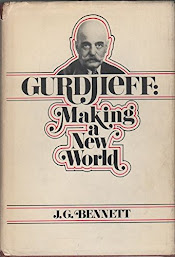
J. G. Bennett on Gurdjieff (book)

There are two ways in which the ascension (spiritual liberation) argument typically occurs. The first is that humans were once grand or at least at a relatively decent level of peace and stability, but have fallen, and to ascend is to take our rightful place by being and acting in accordance with our designed nature (leaving aside the question of the designer). The other is that we act in alignment with the lowly state we are by nature, and ascension is rising above our lot. Gurdjieff sits in the second category, with the general purpose of human life being to act as an energetic resource for planetary forces in the same way as sheep and cows are resources for humanity; however, just as some animals may avoid capture for food and materials or death by another animal, an individual human may escape their bondage by separating psychologically from the herd.   

Gurdjieff states that human beings are in a type of hypnosis, with the added suggestion that this is by design:   

"It must be realized that the sleep in which we exist is not like ordinary sleep but is rather a kind of hypnosis, a hypnotic state that is continually maintained and enhanced…One would think that there were forces that derive some use or profit from keeping us in this hypnotic state and preventing us from seeing the truth…."

He then follows this point with an analogy comparing humans to sheep held in obedience by a magician so as not to run away from their slaughter; however, unlike sheep, humans as a collective are held in a psychological rather than a physical state of bondage. Yet this hypnosis is not unusual or limited to our epoch, but is the standard state of affairs, because if we collectively wake up to the reality of our existence we would cease being of use to those we serve.   

The human element of the control structure, including the groups that operate the financial and political systems on Earth, does not play a role in the classic exposition of his work In Search of the Miraculous written by P. D. Ouspensky. This account of Gurdjieff’s teachings, from where the above quote derives, avoids analysis of the human power structures as its primary point is that cosmological forces control human destiny, including the lives of the wealthy and powerful. This is not to say that there is not a small group that hold the majority of assets, but this does not really matter because that group is also powerless and are simply puppets acting out scripts like the rest of us.   

For Gurdjieff, the heavenly bodies such as Earth, Saturn and the moon are living, energetic entities that are evolving and use human energy for their own purposes; they are our natural rulers (and in some cases predators to use a biologically analogy) which manipulate us energetically via our psyche for their growth and development. Wars, mass catastrophic events, and any forms of intense social division and conflict facilitate the release of energy the moon feeds off. He tells us:  

"The influence of the moon upon everything living manifests itself in all that happens on earth. The moon is the chief, or rather the nearest, the immediate, motive force of all that takes place in organic life on the earth. All movements, actions, and manifestations of people, animals, and plants depend upon the moon and are controlled by the moon…Man, like every other living being, cannot, in the ordinary conditions of life, tear himself free from the moon."

Life on Earth, to Gurdjieff's mind, evolves in relation to the needs of Earth and the moon. He describes how conscious lifeforms, such as humans, act as fine sensory devices which Earth uses for its interactions with other planets, and provide energetic sustenance for planetary forces, most significantly the moon. Gurdjieff notes that everything sets free a certain amount of energy at its death and this is attracted to the moon as through a huge electromagnet, bringing to it energetic sustenance required for its growth.    

We see how plants consume air and water and are then eaten by animals who would not survive without plants; and animals are eaten by other types of animals (including humans). Yet we do not believe humans are food for a more powerful living entity: i.e. we provide no functional role in the advancement of life, but believe ourselves to be the apex of the food chain. Gurdjieff’s student and interpreter J. G. Bennett suggests the commonly accepted idea that humans do not serve such a purpose is hubris, and that the planets are clear examples of the large, and sophisticated forces that could take on this role: ‘it would be absurd to suppose that whereas all nature is connected through the transformations of energy, man alone should somehow stand outside this universal law.’  Yes, when we die our bodies are integrated back into life, but worms and soil could survive without our flesh, but humans and animals could not survive without plants, so according to standard thought, we have no essential purpose within the chain of life.   

An interesting part of Gurdjieff’s theory is that humans often go into a collective psychosis, which is caused by planetary influences. It is such influences that lead to wars, revolutions and other large, civil disturbances:  

"What is war? It is the result of planetary influences. Somewhere up there two or three planets have approached too near to each other; tension results. Have you noticed how, if a man passes quite close to you on a narrow pavement, you become all tense? The same tension takes place between planets. For them it lasts, perhaps, a second or two. But here, on the earth, people begin to slaughter one another, and they go on slaughtering maybe for several years. It seems to them at the time that they hate one another; or perhaps that they have to slaughter each other for some exalted purpose; or that they must defend somebody or something and that it is a very noble thing to do; or something else of the same kind. They fail to realize to what an extent they are mere pawns in the game."

A state of tension thus arises when there is an imbalance in the relations between the planets. The changes in the energetic balance throws humanity off kilter, which in turn leads to wars and other forms of collective madness, a state Gurdjieff calls “Solioonensius”. Gurdjieff points to the fact that in such periods humanity goes into a state of intense self-destruction, and begins to rip down society, including stabilising aspects that allowed it to reach a level we would call ‘civilisation’.    

In these periods, humanity also loses its self-preservation instinct, as the ideas that take hold of individuals override the usual handbrake on collective suicide. He vividly describes this state of collective psychosis as involving the unconscious actions of large amounts of human “machines”, driven by external influences, blindly intent of slaughtering each other, regardless of the negative impact on themselves. Alternatively, some individuals use such periods to work on themselves to overcomes the widespread sense of dissatisfaction which harasses all, and develop their psychological insight and strength. Such periods are a period of harvest where the wheat is separated from the chaff.   

Bennett notes that the two emotions that are uniquely human and which are heightened during such periods of wars and revolutions are hope and fear. These, he states, are deeply connected with the human understanding of life and death, and our knowledge that we are inevitably caught up in such a sequence. We know that things come to an end, and predict the birth of new events, all bringing unique waves of emotion. The moon thus creates situations on Earth where these emotions reach fever pitch, and use politicians, the media, religious groups, and revolutionary leaders for this purpose, although such groups may think they are in control of their actions and working towards noble goals, and are even willing to be martyred for the cause. 

Gurdjieff’s fascinating view of the human condition was first presented to an eager group of Russians leading up to and during WW1 and the Communist Revolution. Clearly, during the revolutionary fervour within Russia during this period, and the outbreak of war in Europe, a view of this kind would have been more easily accepted than in America during the 1990s; and, writing in the year 2022, it begins to have an intuitive appeal once again. However, it is entirely possible that our energy is also food for beings that exist outside the visual bandwidth that we operate. There is a great deal of existence that surrounds us of which we have no real idea what is going on, and the suggestion that we are being fed on by forces outside of our visual spectrum opens one’s one mind to a new and eery way of considering the human life, but a way of thinking the majority of people living in our scientific, materialistic era will reject. 

What Gurdjieff and Bennett point to is our arrogance, including the naïve belief that we have it all figured out, and have access to all levels of existence. It also reminds us of the powerful forces that surround us and the fragility of our rationality and our position in the cosmos. This is hard to accept for someone that takes pride in human advancement within the sciences and their own reason. Yet, if we are honest, we see chaos, dishonesty and madness in all directions. Perhaps the most foolish aspect of humanity is our inability to accept how weak and chaotic we truly are and that there are powers within the universe that influence us to do things we would rather not do. For a recent, scientific account this phenomena in practice, a book titled The Body Electric: Electromagnetism and the Foundation of Life outlines a series of investigations into how planetary influences impact human behaviour, including psychiatric disturbances, and is worth turning to for those wanting to pursue the topic in more depth.    

Getting back to the original point of ascending from the matrix of control, Gurdjieff notes that liberation from our slavery entails systematically escaping the laws of the moon and other heavenly bodies, and working our way up towards a reality where less laws apply to us, many of which are unseen or unrecognised in everyday decision-making and action. The liberation we obtain from the control mechanisms within ourselves, such as compulsive thoughts and hateful emotions, is in fact liberation from cosmic influences that manifest within ourselves. It is in times when humanity is plunging into chaos and self-destruction that we are pushed to such a degree of discomfort that we make the great efforts required to obtain inner freedom, yet to do so we must first be aware of the trap set to prevent our flight.  

Thursday, 3 March 2022

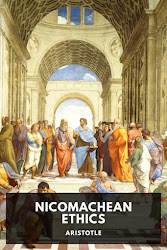
Aristotle's Ethics (book)

A curious fact about the history of ethical theory is that the ancient Greeks did not have a word for happiness; it made no sense for them to speak about the final goal of human action as individual or general human happiness. The Greeks used the word eudaimonia, which is generally translated as flourishing. To flourish, in the eyes of Aristotle, is to fulfil one’s potential as a human being, or to be excellent at being what one truly is.                                                                                                                                                                                                            For Aristotle, in order to know what it means to flourish, it is essential to have a view of human nature. This means, that to know if an individual has flourished as a human, we must have a notion of what it means to be a human so we can determine what kind of things an exemplar human being would do. Aristotle believed that this answer had to be found in biology grounded in sound metaphysics. For example, by nature, human beings are social, so part of human flourishing will entail forming relationships with people, being trustworthy, and caring about others to a reasonable level.

Aristotle’s view was not that we perform a particular action because it is in line with some law outside of us, or because it will bring about a further state (such as a maximisation of human happiness: see Utilitarianism for such a theory). If the action itself is a manifestation of flourishing, then it is a ‘good action’. For Aristotle, the word ‘good’ only makes sense in relation to what the thing is: what its function is. A good knife is one that cuts well, and a good human is one that performs her biological functions well: i.e. is sufficiently social and uses her intellect to plan for the future yet avoid immediate threats.

This view of ethics is appealing because it does not rely on any speculative, eternal ethical laws. The other benefit is that it does not fall into the utilitarian trap of demanding that we act for the benefit of human happiness in general. I can see why I should act for the benefit of myself, or my close family and friends due to natural human sentiment: emotions and ideas springing from basic biological and psychological realities. In contrast, stating that I should act to enhance the happiness of all of humanity seems to stretch my concern for others to excessively abstract and unattainable levels: it becomes unnatural.

The problem facing Aristotle’s ethics is that it is unclear if it would produce the kind of individuals that we typically consider ethical. Looking back at history and around us today, human beings seem inclined to engage in relentless war and atrocity driven by fabricated divisions. Possibly, to flourish as a human is to aggressively dominate anyone outside of my immediate circle. On the other hand, sophisticated arguments can be made that due to the benefits that complex social networks provide to humans, honesty and concern for others are aspects of human flourishing. Quantum physics also indicates that a human being cannot be separated from their environment and other people, so selfishness is against our fundamental nature. 

For me, the appeal of this kind of ethics is that it is fundamentally tied to notions of human nature and can therefore change in accordance with a growing understanding of what human beings are. It can be used by those who are atheists or religious: the only difference is that the conception of what it means to flourish will differ in accordance with what we take humans to be: purely biological beings, or being with souls where connection with God is the highest kind of flourishing. In politics, it means that the final goal of state action is for as many people to flourish or "make the best of themselves" as possible and such behavior should be activity encouraged by the state.  

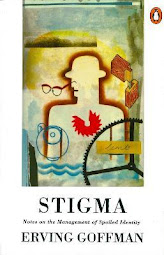
Erving Goffman on Stigma (book)

Erving Goffman established the groundwork for the analysis of the relationship between mental illness and social control in his classic texts Stigma and Asylums. For Goffman, humans live in, and emerge from, interconnected social networks; moreover, individuals within these social networks hold shared expectations about how people will act. Goffman notes that we do not merely expect individuals to live in accordance with these assumptions, but we demand that they do: "We lean on these anticipations that we have, transforming them into normative expectations, into righteously presented demands."  In this way humans transfer conventions or conveniences into implicit behavioural demands, and thereby regulate each other’s conduct.                                                                                                                                For Goffman, when we meet someone we assume that they are going to be a certain way. The group of attributes that we expect people to have constitutes their virtual social identity. On the other hand, the group of attributes that the individual reveals to us constitutes their actual social identity. Tension arises as humans do not only expect that the virtual and social identities of an individual match, but demand that they do.

To possess a stigma is to possess an attribute which is considered inferior to the set of attributes which people within a society expect other people to have:

"While a stranger is present before us, evidence can arise of his possessing an attribute that makes him different from others in the category of persons available for him to be, and of a less desirable kind…Such an attribute is a stigma, especially when its discrediting effect is very extensive; sometimes it is also called a failing, a shortcoming, a handicap. It constitutes a special discrepancy between virtual and actual social identity."

The possession of this undesirable attribute leads society to ‘turn away’ from the individual, as they are rejected by people in blatant or subtle ways: 

"The stigmatised individual is asked to act so as to imply neither that his burden is heavy nor that bearing it has made him different from us; at the same time he must keep himself at that remove  from us which ensures our painlessly being able to confirm this belief about him."

It is noteworthy that, for Goffman, an individual may meet the expectations of other people in nearly every possible manner, yet due to one significant aberration be rejected:

"an individual who might have been received easily in ordinary social intercourse possesses a trait that can obtrude itself upon attention and turn those of us whom he meets away from him, breaking the claim that his other attributes have on us. He possesses a stigma, an undesired differentness from what we had anticipated."

For example, an individual upon entering social interaction might appear to all as normal, but once stuttering manifests as part of the individual’s actual social identity, he moves down the abstract ladder of normality into the subterranean category of abnormality.

To Goffman's mind, humans live by a set of behavioural norms and expect other people to do the same: we unconsciously incorporate an idealised notion of how humans should be, and measure those we meet in relation to it. This ideal incorporates body shape, size, health, life plans, speech patterns, sexual tendencies, and all other aspects of human existence. This would imply that the majority of humans, if not all, would be stigmatized, as the set of social expectations is extremely rigorous and therefore impossible to meet. Goffman was aware of this point and notes that stigma is a matter of degree and everyone will experience it to a  certain extent throughout their lives. However, he differentiates those who will experience a more severe and protracted rejection from their peers, noting: 

"the lifelong attributes of a particular individual may cause him to be type-cast; he may have to play the stigmatized role in almost all of his social situations, making it natural to refer to him…as a stigmatized person whose life-situation placed him in opposition to normals."

Therefore, while a western women living temporarily in Saudi Arabia might experience a sudden, yet transitory, reduction in her value in response to the social values of her new habitat, a little person has an undesirable trait which is consistent and explicit.

The second key aspect of Goffman’s theory is that the stigmatization occurs within the individual herself. Individuals with undesirable traits come to feel that they are undesirable in an objective sense. A process of self-stigmatization therefore occurs as individuals validate the social expectations of the society in which they live, and accept that not existing in accordance with them makes them second-class citizens: the standards he has incorporated from the wider society equip him to be intimately alive to what others see as his failing, inevitably causing him, if only for moments, to agree that he does indeed fall short of what he really ought to be. Shame becomes a central possibility, arising from the individual’s perception of one of his own attributes as being a defiling thing to possess. Self-loathing and role-playing is then taken up by the stigmatized individual as he begins to act in a manner deemed suitable for someone of his claimed inferior status.

The third key aspect of Goffman’s theory is the notion that stigma can be of the invisible or visible type. The nature of one’s disability impacts the extent of the stigmatization that occurs and how the individual acts in relation to the stigma. Mental illness, is more on the invisible side of the spectrum, and therefore, presents stigmatization of a type different to other more visible handicaps; although, mentally ill individuals often display symptoms, albeit often in a less obvious form than other kinds of difference. The key point for Goffman is that those with invisible stigmas can hide them from the population and “pass” as normal. The strategy for dealing with stigma surrounding mental illness will therefore take this factor into account, as the question emerges whether trying to pass as normal is a form of self-stigmatization.

Goffman’s work set the foundation for the study of stigma. However, it has various drawbacks. Firstly, he primarily dealt with how individuals categorised as mentally ill were sent to mental hospitals as the primary form of discrimination, which in turn allowed for additional discrimination and reinforcement of the inferiority of the patient through the actions of the psychiatrists and the structures of the institutions. With the process of deinstitutionalisation that occurred throughout the second half of the twentieth century, the stigmatization of the mentally ill is no longer best evaluated through an examination of mental hospitals, but instead within the community, where the majority of mentally ill persons live. Moreover, Goffman did not deal extensively with the question of whether the labelling of an individual as mentally ill is what leads to her rejection from society, or whether it is the behavioural traits and subconscious beliefs which are said to constitute the illness that leads to ostracism. 

Self-Reliance (book)

Ralph Waldo Emerson always struck me as cutting to the heart of human weakness: the tendency to ignore the advice coming from our hearts due to the desire to obtain the approval of other people. We are here for a reason, and it is our intuitive voice that will guide us towards our rightful destiny, not the judgements or demands of other people: “What I must do is all that concerns me, not what the people think.”                                                                                                                                                                          Many of my favourite writers talk about the importance of trusting our intuition, and the messages and feelings that support it and which we can pick up on when our eyes are open and our minds are alive. Each of these writers emphasises a different aspect of this. For example, Florence Scovel Shinn wrote extensively on following the leads that one's higher self provides in practical affairs: “The Divine Plan unfolds through following intuition.” Emerson also implores one to listen to that voice within, because for him it is where greatness and genius reside. Of this Emerson notes:

“Trust thyself: every heart vibrates to that iron string. Accept the place the divine providence has found for you, the society of your contemporaries, the connection of events. Great men have always done so, and confided themselves childlike to the genius of their age, betraying their perception that the absolutely trustworthy was seated at their heart, working through their hands, predominating in all their being.”

Without listening to the intuitive voice within, we will be led down a path designed for another; most often because our doing so is for their psychological or practical benefit not ours. Moreover, when this happens the universe will conspire to get us back on our rightful track with a violence that could have been avoided if we had only trusted what we knew to begin with. Just ask yourself how many times you thought or even exclaimed out loud, ‘I knew I should have done that,’ or, ‘I had a feeling not to do that.’ In these situations we ignored our higher self and its intuitive leads; we violated our purpose to appease the crowd. 

The main issue preventing us from becoming great is, for Emerson, conformity to social demands. Yet, this conformity is rooted in a lack of courage to go with what we know is true. When we lack faith in ourselves we go along with the crowd even when we know deep down they are wrong. History is full of lessons where the crowd got things terribly wrong, and when people stand down from their convictions due to a lack of courage, society inevitably crumbles or turns into something extremely evil. On this Emerson notes:

“Whatever you do, you need courage. Whatever course you decide upon, there is always someone to tell you that you are wrong. There are always difficulties arising that tempt you to believe your critics are right. To map out a course of action and follow it to an end requires some of the same courage that a soldier needs. Peace has its victories, but it takes brave men and women to win them.” 

The lack of courage to do what we know in our hearts is right can spring from a lack of self-belief, fear of future hardships, and perhaps the worst of all – an excessive concern for what people think about us. There is nothing more psychologically crippling than a great concern for what others think about you. Emerson however tells us over and over again, if we cannot overcome this, we cannot achieve greatness or come anywhere near it. He points to the many examples of historic heavyweights that were ridiculed and persecuted by their peers:

“Is it so bad, then, to be misunderstood? Pythagoras was misunderstood, and Socrates, and Jesus, and Luther, and Copernicus, and Galileo, and Newton, and every pure and wise spirit that ever took flesh. To be great is to be misunderstood.” 

Just as Emerson was inspired by the examples of those preceding him, we can turn to Emerson himself as another example of this trend. When researching his work for this piece, I was surprised to discover that his wonderful essay On Nature was at first poorly received, and only read by a small group of his friends and associates. Furthermore, after giving a speech at Harvard Divinity School Emerson was banned from coming back after the crowd was mostly insulted by his interpretation of the Scriptures. It is worth considering that if you are presenting ideas that you know in your heart are true, and are being persecuted for doing so by society at large, you are potentially on the cusp of greatness. Keep pushing through, because eventually the dam will break, and you will be flooded with the waters of success and refreshed by a life of purpose. 

Notwithstanding the above point, Emerson also warns us not to lose our divine spark in the imitation of the great people that came before. It is in the transcendence of past ideas, events and minds that the history-shapers of today emerge. He cuts to the point, exclaiming: 

“There is a time in every man's education when he arrives at the conviction that envy is ignorance; that imitation is suicide; that he must take himself for better, for worse, as his portion; that though the wide universe is full of good, no kernel of nourishing corn can come to him but through his toil bestowed on that plot of ground which is given to him to till. The power which resides in him is new in nature, and none but he knows what that is which he can do, nor does he know until he has tried.”

Yes, we learn from history that the masses will try to cut down any flower that bursts through the weeds and begins to bloom too brightly. We can learn a great deal from past writers, painters, musicians and shamans, but our star can only shine when it is truly our own – when its light emanates from within. 

Wednesday, 10 November 2021

Slow West (film)

I'm unsure what genre this film would be: it is sweet and dreamy yet contains emotional turmoil and tragedy with a splash of absurdist humour. It could be best described as "philosophical-action". It is set in the wild west days of northern America where the western frontier was abound with lawlessness and life was cheap. The main protagonist is a thin, pale Scottish lad, Jay, with large blue eyes. He has arrived in America and is heading westward in search of his lost love Rose Ross. Rose and her father John were falsely accused of murder and fled Scotland. As per the American dream, they came to start a new life somewhere on the frontier.

Jay is a romantic pacifist without a single violent bone in his body. He looks at the stars, ponders about the natives on the moon and recites poetry. He doesn't know how to shoot a gun nor has the gumption to use it; he is completely hopeless out in the wild. Jay meets Silas (the lone ranger) by happenstance and the two make a deal where Silas will escort Jay safely across the western frontier to Rose in return for a sum of money. Silas is a man of few words that carries a lot of loneliness and pain. He grew up with a gang of bounty hunters but peeled himself away from them to seek a life of peace while at the same time putting a target on his back: a deal with the devil is always hard to break.

Initially, Jay doesn't entirely trust Silas and attempts to make the journey himself. In his final attempt, he gets seduced by Werner: a man of knowledge and wisdom who also ponders about the world and the meaning of it all. There is a segment of a philosophical discussion that takes place between them. Werner is in the process of capturing the knowledge on the lives and culture of the native Indians as, in his opinion, once they are near-extinct and become the minority to the Europeans, their culture and existence will be romanticised and exoticized without any objectivity The two spend the night wondering about time, the universe and fleeting human existence.

The scenery in the film is simply stunning and the white clarity of the sunlight adds a surreal feel to the film. It is fantastic to see the New Zealand landscape presented in its raw beauty without adulteration by any CGI which sometimes happens in other major films set in New Zealand.

As Jay and Silas continue on in their journey, we discover that there is a handsome bounty on Rose and her father and all the bounty hunters are heading out west alongside Jay and Silas. It is a matter of time before they are found dead or alive as $2000 sits on their heads and Jay and Silas must get there before the bounty hunters.

I am unsure what to make of the humour in this film except to compare it to the likes of Park Chan-wook's films (especially Old Boy). It is at times “inappropriate”, but also fun and childlike. For me the humour exalts Slow West into a reflective work of art rather than a standard western as the humour diminishes the dominating force of the violence and brings to focus the hero's journey each human is embarked on.

Sunday, 21 January 2018

The Death of Louis XIV (film)


The climax of the film perhaps starts and ends with the title. The grandiose phrase announcing the king’s death. The viewers are then carried gently down the two hours of exquisitely produced ‘slow death’ river. It is not merely the death of a king, but of rational thought and purpose. We see a failed state, drowning in its champagne induced vomit, unable to take action.

We see the sycophantic servants pandering to his Majesty’s every need, while undertaking warfare of ego and pettiness among themselves. But this is just a manifestation of the systematic decay that had set in and been seething for a long time, getting more absurd each day. The level of corruption so great and the suffering of people so horrific it mobilized the citizens to take action just a generation later.

In our lives, we see the EU and the UN growing morbidly obese in their spirits, its members squabbling over career opportunities and political grandstanding. We see politicians, instead of bringing people together, choosing to divide the population by identity politics to raise their popularity. Ideologies have become dull to the changes that have occurred around them. Institutions like the FBI are used as political tools against opponents. Where are the concerns for the population? for public service? Such purposeful question have long been forgotten among our leaders.

The film is beautiful to watch, reminiscent of Kubrick’s Barry Lyndon in texture and light. The level of luxury is quite intense to watch as (in The Death) each activity, no matter how banal, is completed with the most ceremonial trimmings one could possibly imagine. It’s exquisite, it’s comical, and it’s grotesque. I would highly recommend this film to anyone that thinks about the world.

While The Death of Louis XIV for me is in a way an expression of the status quo in the governance across our civilization, I do not despair. We see signs of changes already and Nature says what is so corrupt and self indulged eventually gives away. We’ve seen presidents get impeached, a decision made after pending for decades-Jerusalem (for better or for worse), drug reform happening all around the world, heads of state in western democracies being led by many women, reforms in Saudi Arabia, an invigorated African economy; for me, these are all indications that positive changes are abound. From time to time I think it is worth asking ourselves what this is for? As I write and reach out to you, I believe the ultimate purpose of politics and media is communication with each other for the betterment of humanity.


Tuesday, 19 December 2017

Fanny and Alexander (film)


This was a film that was made at the end of Bergman's life and there is a feeling throughout the film of reflection tinged with nostalgia, and dotted throughout with autobiographical material.

Set around the beginning of the 20th century, this is a fairytale like story of the Ekdahl family told through the eyes of its youngest Fanny and Alexander. The film opens on the eve of Christmas where the grand Ekdahl household is bustling with preparations for festivities. There is something comforting about watching all the Christmas decor, food, and traditions that were being observed. It reminds me of what Ang Lee said about his work in Eat Drink Man Woman: time and time again he would present an amazing spread of food that goes uneaten inducing a feeling of yearning or dissatisfaction. Bergman seems to play on this idea but produces the opposite effect (I'm not suggesting that Bergman was inspired by Ang Lee and it wouldn't be possible as EDMW came out in 1994). The early part of the film is filled with drinking, eating, dancing, joking, and fornicating to excess as if to demonstrate the energy of youth and strength. It's as if Bergman was reminiscing his early energetic years as he makes this film near the end of his career.

But it's not all fun and games for the Ekdahls, particularly for Fanny and Alexander. Illness, death, as well as birth and marriage come and go as tides, changing people, their physique, attitude, strengths and weaknesses, and their hopes and dreams. Towards the end of the film, I came to realise that Fanny and Alexander as children merely float away like buoys in the waves of an environment created and amended by the adults around them and their happiness is a litmus test to the wellbeing of the entire family. 

The future Bergman envisioned at the time of the film, and quite correctly, was a world where women were more in control as the final scenes allude. We also encounter the message that institutions and those representing them, either religious, political or educational, often have the opposite effects and intentions to those they preach, and that joy and kindness is found in unexpected places. It is a beautiful film filled with lush magical scenery which is what I look forward to seeing from Christmas films, and expresses a kind and hopeful sentiment I hope you enjoy. 

Friday, 15 December 2017

Things to come ; L'avenir (film)


I am loving everything with Isabelle Huppert in it lately and this quirky, thoughtful piece certainly did not disappoint.

Isabelle Huppert plays Nathalie Chazeaux, a philosophy teacher who initially seems to have lots of good things going for her. Her and her husband seem to have a solid relationship (he also teaches philosophy at university), she gets along with her children and her rather difficult mother, and she has been in her field for more than a decade yet is still enthusiastic about philosophical ideas.

What becomes clear through a series of events is that she is detached from the ideas and principles she teaches. The viewers get a glimpse of this when she refuses to allow students to have a debate about a current political event insisting that they are there to "learn" about. She fails to realise that students thinking and talking about current events becomes more urgent and real when applied to life.

Despite how many philosophers she can name, to her, they are merely the subject matter of her teaching profession. The film seems to be poking fun at the consumerist culture that dehumanizes the process of production and consumption. Expanded into academia, education is a "product" or "service" rather than an advancement in the way people think about the world and the improvement of character.

Nathalie acts as a passive deliverer of ideas to her students as much as she passively consumes ideas from the books she reads. She is embarrassed and dismissive of her more passionate younger self but she's stuck in the present and unable to move on, like how her and her husband play the same few composers decade after decade, afraid to try out something new or different for fear of failure or ridicule. The modern world is calling on Nathalie to engage and get more involved but not in the way she would like to; the marketing team wants her book cover re-designed with bold patterns and colors to attract more consumers: Nathalie is repulsed.

Overnight, everything changes: Nathalie's husband has an affair and leaves her, her mother dies leaving behind a cat, her book deal is off, one of her favorite students is critical of her, and she becomes a grandmother. We see Nathalie become irrational and child-like, overwhelmed by her emotions, and far removed from the thoughts and discussions she preaches. "But isn't that the most human response?" the film seems to be asking: the views of the audience will vary depending on each person's own experience and that's what makes this film so fantastic.

Wednesday, 1 November 2017

Theft by Finding: Diaries (book)


Sitting down to type this piece, I had a look at the catalogue of Sedaris' work and realised that the majority of his work is now auto-biographical. In fact I haven't read a single fiction piece by Sedaris, all of my exposure has been through his auto-biographical stuff.

This book contains his diary entries from 1977 to 2002 which are the nuggets of raw material that make up the vast range of his work from the late 90s. For a Sedaris fan like me, who cannot get enough of his humour and perspective of the world, it was a pure joy to read with moments of cackling out loud. The diary entries paint what it was like to live in big tough cities like Chicago and New York in the 70s and 80s: it just seems like you couldn't really walk around carrying anything of great value because there were constant threats of getting mugged.

There are somber moments too like when one of the earlier entries talk about this new 'cancer' that's been found that "only kills homosexuals". But the book is ultimately a coming of age story and it is a happy story as cliché as that may seem. His early years struggling with money and working in odd jobs, his art, his work in theatre and teaching as well as his drug habits all chronicled and I despaired with him when he got bullied yet again and cheered for him when he got his first review in Time. 

Is it considered unusual releasing a diary when you're still alive? I suppose that is Sedaris' style as the guy pretty much invented the genre of oversharing or, perhaps better put, a hyperrealist literary style. Some may find it over self-indulgent having so many books that are auto-biographical as well as getting the diary itself published. But ultimately it's not about David Sedaris, rather he is the lens through which you see the world and it is an interesting and hilarious perspective and although not overly educational or intellectual, it quenches the thirst of your soul like a glass of tart lemonade.

So I suppose you could say that Sedaris is my guilty pleasure. One thing this book has done is highlight for me the importance of writing in a diary or journal or even blogging as a medium. I think the contemporaneity of entries gives off something that is so unique it cannot be produced elsewhere. There is something cool about how certain entries just capture a particular moment in time perfectly. 

Tuesday, 31 October 2017

Ozark (Netflix series)

This satirical series starring Jason Bateman and one of my most favourite actresses, Launa Linney, is beautifully shot and superbly acted.

Marty Byrde (Bateman) is a successful financial advisor living a boring and unhappy life. Perhaps he lacks a certain joie de vivre, or is too risk adverse, or perhaps he is just down right stingy. Due to his business partner getting involved with organised crime, Byrde ends up owing money to a Mexican cartel: five million dollars. He cashes out the entire investment portfolio he had been squirrelling away for years as he loses everything to the cartel and has to launder that money on the shores of the Ozarks.

The Ozarks as presented is a place that feels like the location of Deliverance most of the year, but a scene out of Spring Breakers for a few weeks in summer. Byrde presents himself as an 'angel investor' and offers to invest and help out struggling local businesses. The locals are weathered and sinister as they have been ripped off by city-slickers one too many times. It's a love-hate relationship.

What makes Ozark different from other small-town-meets-drug-crime series (Bloodline, Fargo, The Affair) is that it's more about the financial and business side of things - the process by which the proceeds of drug sales come into the mainstream economy. As Byrde's son points out to his school teacher, some argue drug money was the only thing that was keeping the US economy afloat during the recession. So you don't really get the tediously long sequence of scenes showing large amounts of drugs being produced and distributed which can get quite boring.

The Byrde family settles down in a beautiful lakeside house in the Ozarks. Marty and his all-but-divorced-wife Wendy (Linney) agree to stay together as 'business partners' for their two kids who are starting to act up against their new, absurd living arrangement. But Wendy and Marty also make great work business partners and Wendy's skills bring an extra limb to the money-laundering operation.

Ozark is a search for a meaning in the confused and divided America of the Trump era. A country divided by the different values held by the rural poor and the urban wealthy; the traditional and the corporate; and the godless and the religious. In this cacophony of principles and values, what drives a shrewd modern pragmatist to act like a decent human being? The answer isn't always one of financial incentives as life itself tends to demand consideration of higher goals and values shared with others.

Monday, 1 May 2017

Personal Shopper (film)


I read a horrible review of this film and another glowing review so I thought it was worth a punt if it could be that divisive. After seeing it, twice, I must admit I agree with the latter review. I should disclose that I’m also a fan of Kristen Stewart, I think she is one of the best actresses of our time.

Personal Shopper is a complicated piece exploring ideas of longing, desires, searching and at the same time being imprisoned by them. It plays out from the idea of a personal shopper: a person that occupies neither the world of celebrity nor an average person; a person that sits in the middle accessing both worlds, like a medium, with the spiritual world.

Kristen Stewart is a young American woman working as a personal shopper for a celebrity in Paris. Stewart glides around the most glamourous stores to pick up items for her high profile celebrity whom she hardly sees. The tasks themselves are mundane and involve lots of travelling around. She is somewhat envious of the life of glamour and she dares to try on the clothes from time to time but it’s not what she wants deep inside. She wants to be free and not be bound by any corporate ideal.

She spends the rest of her time looking for a sign from her late brother. He was a medium and could talk to spirits when he was alive. She wants him to give her a sign that there is another world out there, a spiritual world. What it would mean for her if this other world did or didn’t exist is not clear in the film and I don’t think she even knows herself. At the same time, Stewart has unshakable skepticism as to her brother’s ability as a medium. When the widowed sister-in-law describes how he used to talk to spirits from biblical times Stewart tries to dismiss it as an impossible lie. Stewart visits her late brother’s house in Paris to see whether his spirits will emerge, then has a frightening experience when something other than her brother’s spirit appears. Stewart’s personal shopper job ends when she comes across a stalker, whom she falsely believes could be her brother talking to her from the spiritual world.

Personal Shopper captures the hollowness of our hyper consumer market: the constant longing and desire created by the bombardment of advertising. At the same time we are never fully satisfied and continue to search for the next amazing experience while dismissing our current life as boring or meaningless; trapped in a constant state of desire. The film has a cautionary tale: Stewart’s aimless pursuits do not bring her any happiness or satisfaction and they actually put her in danger; as if to say: be careful what you wish for.

Wednesday, 22 March 2017

Elle (film)


Elle directed by a Dutch director, Paul Verhoeven, is one of the most classy and subtle satires to have come out in decades. It’s a story about a female CEO Isabelle: she is elegant, aloof and has a knife-sharp tongue. She speaks her mind and that makes her unlikeable to many other people. She is great at her job and has complete authority over her staff. This Isabelle gets attacked at her own home by a masked stranger: an event that has a puzzling impact on Elle.

What follows is a weird symbolism of empowerment and denigration of the physical body. I think what the film is trying to say is there are many other ways to violate a person’s sense of self and sometimes humiliation, faith or psychological abuse has far greater consequence than something like a rape incident. For Isabelle, rape and physical violence do not rank highly in what is most damaging to a person. In fact, most of the time she doesn’t seem to get upset, which makes her seem almost in-human.

The film explores various other ways a person can be violated. Some obvious and some not so: financial abuse, verbal abuse, stalking, cyber bullying, infidelity, grave desecration and so on. It also suggests that acts of extreme violence, such at what Elle endured as a child, can harden one to the point that violence of any sort is normalised: this idea is the essence of trauma-based mind control. 

I’m not sure if I’d call this a feminist film because while the main character is a woman and it is about empowerment I wouldn’t say it’s about female empowerment. The final message of the film is essentially that: power-over-self can manifest in many ways and can be maintained even when power-over-body has been violated. I think the fact that Isabelle’s personality appears so unusual is a testament to the flaw in the film’s message. It may not be such a gross violation for an unusual person like Isabelle but to most of us I think it is in-human to separate power-over-self and power-over-body so completely.

Nevertheless, I really appreciate the topic that the film explores and it does it in a way that is interesting, shocking and at times quite sweet.